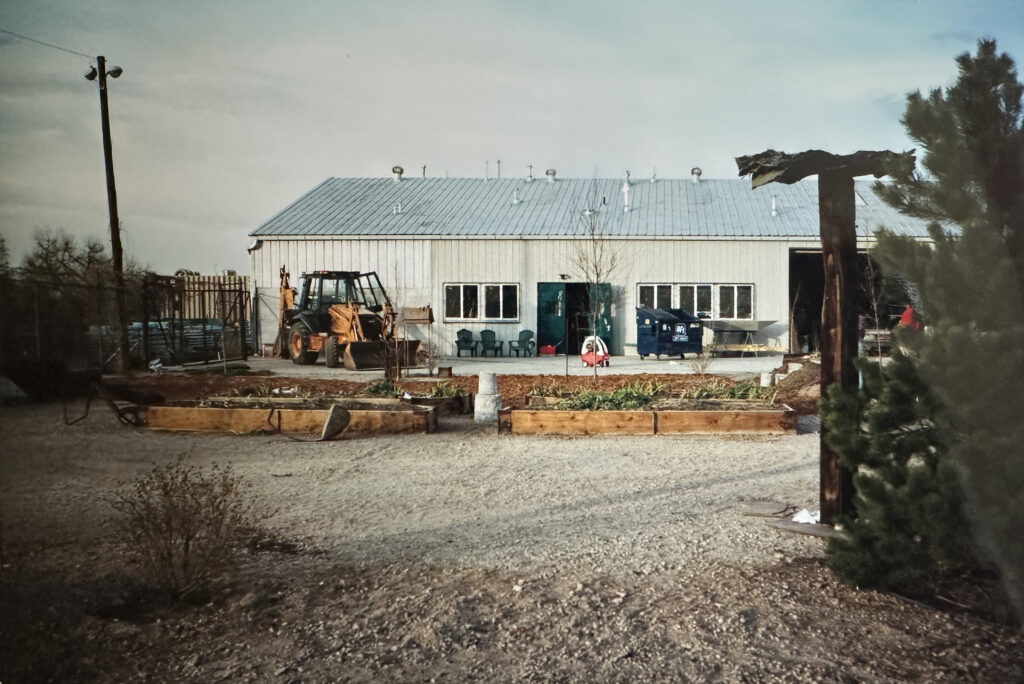
Sometime in 1999, Denver artist, Russ Beardsley found a building on a hardscrabble corner lot two blocks up from the Platte River, in what was then a light industrial district just outside downtown Denver. It was a large metal structure that had spent its life as a van repair shop, sitting behind a chain-link fence with nothing particularly inspiring about it. But Russ, a sculpture graduate of the University of Colorado at Denver, had long dreamed of building a studio and shop space where local artists could work and exhibit freely, saw something else entirely: infinite possibility.
He first brought in his friend and fellow UCD sculpture alum, David Walter. Soon after, Mike Mancarella—another UCD alum, in photography and sculpture—asked to join them. I was, at the time, an associate professor of photography at UCD, and Russ’s partner. Together, we bought the building in 1999, with no clear idea of exactly what it would become, only a shared conviction about what we were committed to.
Our priorities were simple to name and a lot of work to build: a welcoming, spacious, beautiful compound where each of us had our own studio alongside shared spaces for welding, woodworking, and photography. We wanted the same for other artists—real working space at below-market rent, with the collective support of a community around us. We knew firsthand how hard it was to find adequate space to create, and harder still to exhibit without inflating prices or splitting sales with a commercial gallery. So we built a gallery too, and ran it differently: artists proposed exhibitions, we chose them by committee, and we never charged for the space or took a cut of any sale.
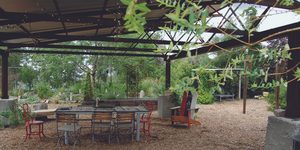
We held monthly meetings from the moment artists moved in, often in the community kitchen we built, or in the gardens just outside. Russ took the rubble concrete pulled from the original floor as we carved out studios and turned it into dry-stack raised garden beds, ringed with sitting areas and outdoor sculpture. There was also a fire pit, an outdoor kitchen, and a childrens’ sandbox. Our two children—and David’s son, and Mike’s daughter—grew up underfoot at gallery openings that spilled outside when the weather allowed, absorbing an atmosphere that was eclectic, warm, and unmistakably collaborative. A place for families and community.
Ironton reached beyond our own walls. We partnered with UCD to offer internships to fine arts students, and with a local organization supporting artists with disabilities who wanted a place to develop their own creative practices. Both partnerships gave back to us in multiple ways.
None of this process was easy. We were opinionated, creative people who didn’t always agree on the long list of decisions to be made in the building and managing of Ironton. But none of us could have built what we built without one another. In 2005, Russ and I moved our family to the Pacific Northwest to chase another set of dreams, and Ironton went on without us. Looking back, those years remain among the most satisfying, difficult, exhilarating and rewarding of our lives— a small proof of what’s possible when people work toward something that serves them and their communities at once.
Before Russ and I left Denver and Ironton we wanted to be sure we were leaving it in good hands. Mike and David’s hands were full with their own creative work and fabrication business’ so we needed to bring someone in to continue to run the gallery and interface with artists and the broader Denver community. Hadley Hooper was already in residence with us at Ironton in her own painting studio and was both willing and beyond capable of filling these roles.